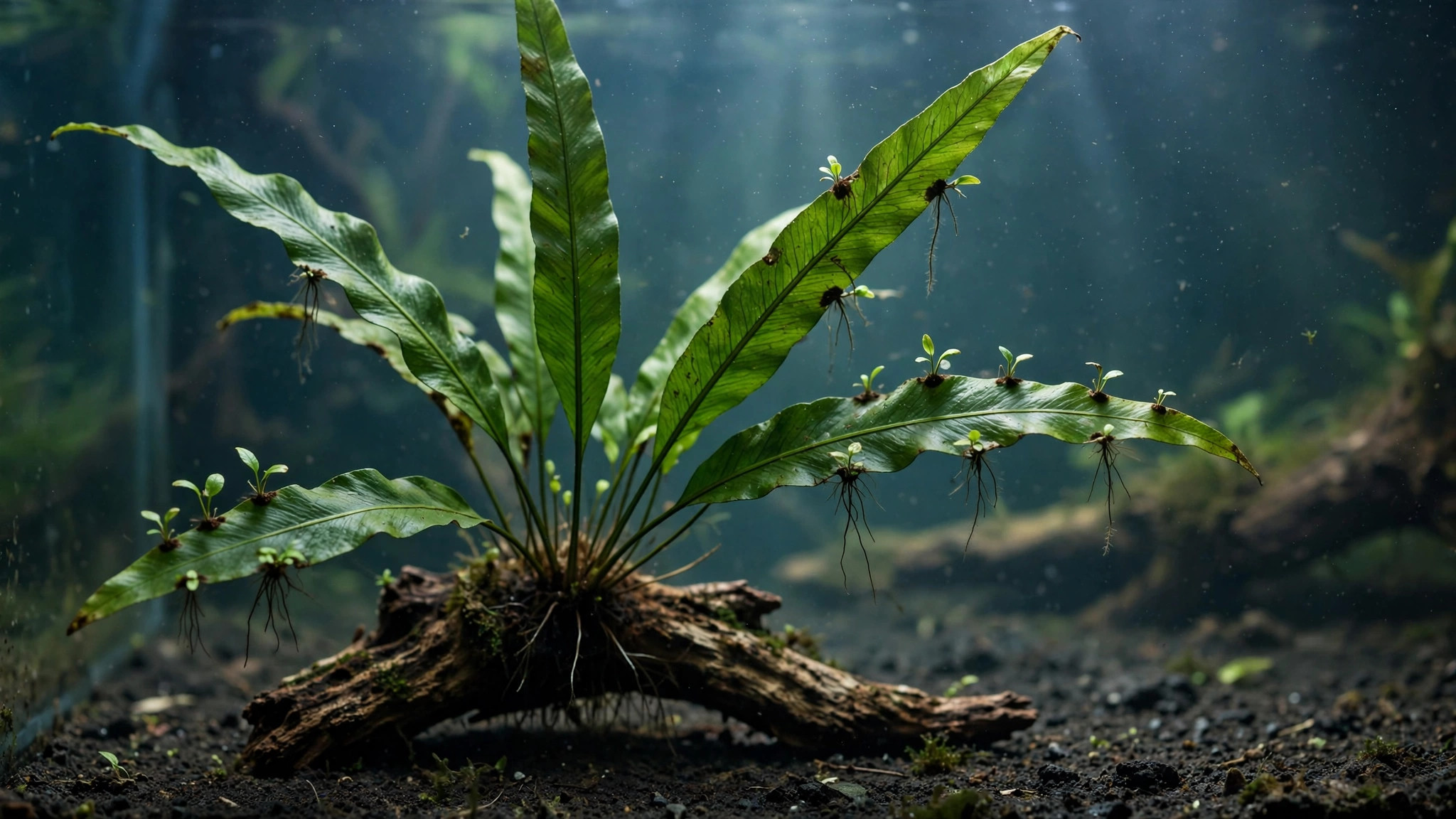
Those black bumps on your java fern leaves are not a disease — they are babies. A mature java fern clones itself by growing miniature ferns, called adventitious plantlets, directly on its older leaves. Each one comes pre-fitted with its own tiny leaves and roots, and every one of them can become a full-sized plant you never had to buy. The catch: most people panic and prune the leaf off, killing the free plants along with it.
What Those Black Bumps Really Are
Java fern (Microsorum pteropus) reproduces by apomixis — making exact clones of itself without seeds. On a mature leaf, usually one of the older ones near the base, the plant forms dark, slightly raised spots along the leaf edges and underside. Watch closely over a week or two and you'll see each spot sprout miniature leaves and hair-like brown roots. Those are plantlets, and a single leaf can carry a dozen of them.
The parent leaf's job is nearly done at this point. It slowly darkens and grows ragged as it shuttles its stored energy into the babies, which is exactly why this whole process gets misdiagnosed as a disease. A plantlet-producing leaf can look dreadful and be completely healthy — it's a sacrifice leaf, not a sick one. Leave it alone until the plantlets are ready; pruning it early throws away every baby growing on it.
Plantlets vs. Black-Spot Disease: How to Tell
Before you celebrate, confirm you're looking at reproduction and not a real problem. The distinction is simple: plantlets mean life is appearing on the leaf. If the black areas are producing tiny green leaves and roots, it's reproduction. No intervention needed.
| Sign | Reproduction (plantlets) | Real problem (rot) |
|---|---|---|
| Location | Dark spots on leaf edges/tips; plantlets visible | Patches anywhere on the leaf, spreading inward |
| Tissue | Firm; leaf may darken but stays stiff | Mushy or translucent; falls apart when touched |
| Rhizome | Firm and green-brown | Soft, stringy, or foul-smelling |
| What to do | Nothing — let the plantlets grow | Cut back to firm tissue with a clean blade; reattach the healthy part |
One more look-alike to know about: neat rows of tiny raised brown dots on the underside of older leaves are spore pads (sori). They're harmless, need no treatment, and are a different mechanism from plantlets entirely.
When Plantlets Are Ready to Detach
The single biggest mistake with java fern plantlets is harvesting them too early. A plantlet with one tiny leaf and a stub of root is not independent yet — detach it now and it usually stalls and dies. Use this readiness test instead:
- Leaves: the plantlet has 3–4 distinct leaves of its own, each a few centimeters long.
- Roots: visible brown roots reach roughly 1 inch (2–3 cm) long and wave freely in the water.
- Timeline: from first appearance, this takes roughly 6–8 weeks in a typical low-tech tank — about 2–4 weeks for roots to form, then another few weeks for leaves to fill out.
If you're unsure, wait another week. Plantlets can stay on the parent leaf for months without harm; they simply detach on their own when ready and drift around the tank. The only cost of patience is a slightly scruffy-looking mother leaf.
How to Detach Plantlets Safely
Detachment is almost embarrassingly easy, which is part of the plant's charm. Work with clean hands and follow these steps:
- Gently pull: grip the plantlet at its base — where it meets the parent leaf — and rock it sideways. Ripe plantlets pop off with almost no resistance.
- Don't force it: if a plantlet resists or tears the leaf, it's not ready. Leave it and check back in a week.
- The alternative: leave the parent leaf alone entirely and let the plantlets drop naturally, then fish them out from wherever they land.
- Never "plant" them: plantlets have a miniature rhizome at their base. Burying it in substrate will rot it, exactly as it does for the parent plant.
Attaching the Baby Ferns to Hardscape
A detached plantlet is a fully formed epiphyte that needs the same thing its parent needed: something solid to hold onto while its roots grip. You have two reliable methods.
Thread or fishing line. Press the plantlet's root mass against a piece of driftwood or a rock and wrap cotton thread or clear fishing line loosely around it two or three times. Cotton thread eventually dissolves on its own, which is convenient; fishing line needs cutting away after a few weeks once the roots have taken hold.
Gel cyanoacrylate glue. The faster, cleaner option: pat the spot dry-ish, dab a pea-sized drop of gel super glue on the hardscape, press the plantlet's base into it for 30 seconds, and lower it back in. Gel glue is aquarium-safe once cured and sets underwater. As an Amazon Associate I earn from qualifying purchases — if you don't have a tube on hand, an aquarium-safe plant glue like Seachem Flourish Glue ★4.3 is exactly this job: one dab per plantlet, no threads to remove later.
Give the babies shade. Young plantlets burn easily, so tuck them in a spot that gets gentle, indirect light rather than the blast zone directly under your fixture. They'll creep toward brighter positions as they mature.
Feeding Young Plantlets (and What Won't Work)
Java fern — baby or adult — feeds from the water column, not from the substrate. Its roots are for gripping, not for eating. That means root tabs are useless for plantlets; the nutrients never reach the plant in a usable way.
What does work is a lean liquid fertilizer dosed lightly. Baby leaves are small and young tissue is sensitive, so start at half the label dose and watch the color: new leaves should emerge a clean bright green. Pale or translucent new leaves usually mean the tank's water column is too lean; bump the dose slightly. An all-purpose option like Seachem Flourish ★4.7 dosed once a week at reduced strength suits slow growers like java fern — it covers iron and potassium without the heavy phosphate load that invites algae in a low-tech tank.
The Plantlet Timeline: What to Expect
Java fern is a slow plant, and its babies follow the same unhurried schedule. Here's a realistic week-by-week picture for a typical low-tech tank at tropical temperatures (24–26°C):
| Week | What you'll see | What to do |
|---|---|---|
| 0–2 | Dark bumps on older leaves; tiny leaf buds emerge | Nothing. Don't trim the leaf. |
| 2–4 | Hair-like roots sprout; buds unfurl into visible leaves | Still nothing. This is the hands-off phase. |
| 4–6 | Plantlet has 2–3 leaves; roots lengthening | Prep driftwood or rocks where babies will go. |
| 6–8 | 3–4 leaves; roots ~1 inch; some detach on their own | Detach ripe plantlets; attach to hardscape. |
| 8–12 | Attached plantlets grow new leaves from their own rhizome | Begin half-dose liquid feeding; remove thread/glue remnants. |
From first bump to independent baby is about two months, and the whole process repeats continuously on an established plant. One healthy java fern can realistically produce a dozen new plants in a year without you lifting a finger beyond the harvest steps above.
What If You Don't Want More Plants?
Sometimes free plants are a burden. You have three honest options: pluck the plantlets while tiny and compost them (the mother plant won't mind); pinch off the dark-spotted leaves entirely before plantlets develop; or run slightly lower light, which slows reproduction since the plant has less energy to spare. Reducing light also slows overall growth, so use this one knowingly.
Or — the aquarist's classic — give them away. Baby java ferns are one of the most welcome freebies in the hobby; a small plastic container and your local club's swap table will clear a dozen plantlets in an afternoon.
Frequently Asked Questions
Why is my java fern turning black on the leaves?
Most likely it's producing plantlets — black or brown spots along leaf edges with tiny plants forming on them are reproduction, not disease. If the leaves are mushy, translucent, or the rhizome is soft, that's rot and needs cutting back.
Can I just leave the plantlets on the leaf?
Yes. Left alone, ripe plantlets detach on their own and drift until they snag on hardscape or substrate. Many hobbyists let this happen and simply relocate the babies where they want them.
How long until a plantlet becomes a full plant?
Expect 6–8 weeks for a plantlet to become independent enough to detach, then several more months of slow growth before it looks like a mature fern. Java fern grows slowly — a new leaf every couple of weeks in low-tech tanks is normal.
Do plantlets need CO2?
No. Java fern propagates fine in low-tech tanks on ambient CO2. Supplemental CO2 may speed growth slightly, but it's not required and won't meaningfully change the plantlet timeline.
Can I plant baby java ferns in substrate?
No — never bury the rhizome, baby or adult. The rhizome must sit on top of hardscape or substrate surface, exposed to water flow. Buried rhizomes rot. Roots may dangle into the substrate, but the rhizome itself stays out.
Why aren't my plantlets growing even though they detached?
Usually one of three things: they were detached too early (under 3 leaves), they're in too-strong light and stalled, or the water column is nutrient-starved. Give them shade, wait, and add a lean liquid fertilizer — most recover within a few weeks.