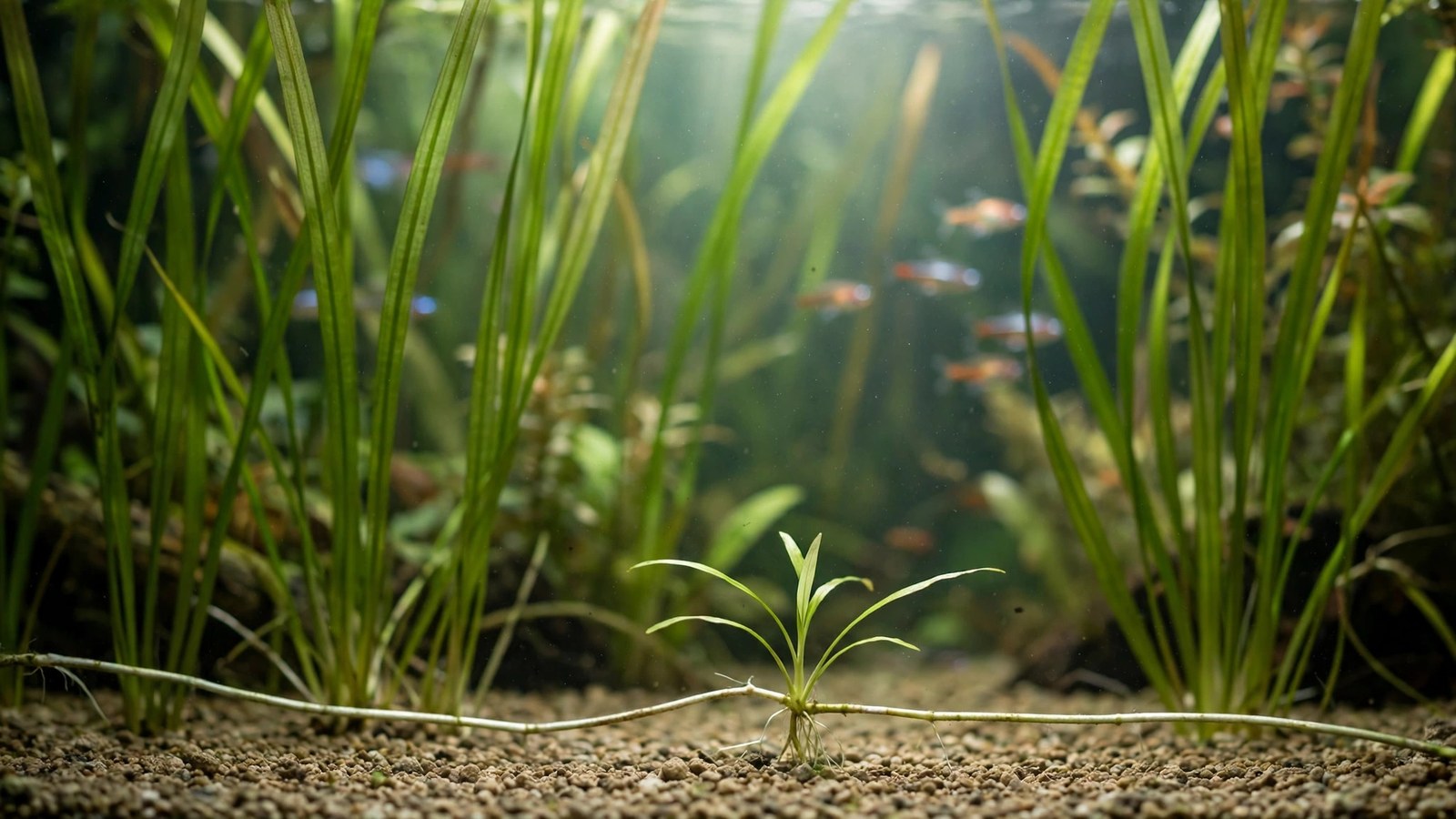
You press the little plantlet into the gravel, and by morning it is floating at the surface like a lost leaf. Vallisneria is not difficult — the mistake is almost always the same: the plantlet went in before it could hold itself, or it went in too deep, and the tank finished the job overnight.
A runner is not a cutting you plant and hope for the best. It is a lifeline from a mother plant, and the daughter at its tip needs its own roots and leaves before it can live alone. Get the timing and the depth right, and one Val can fill a background in a season.
How a Vallisneria runner actually works
A runner, properly called a stolon, is a horizontal stem growing out from the base of the mother plant, along or just under the substrate surface. At its tip a daughter plant forms: first a few ribbon leaves, then a tuft of white roots. While attached, the mother plant feeds it. That is why a runner plantlet can look perfectly healthy while having almost no roots of its own — and why it floats the moment you cut it too early.
Left alone, runners do the aquascaping for you: a settled plant sends runners in every direction, and each daughter sends out runners of its own. Aquarium Co-Op's guide to planting grass-like plants makes the same point — separate pot plants into individual crowns, because a crowded bunch cannot run.
When a daughter plant is ready to move
Judge readiness by roots, not leaves. A plantlet with long leaves and a few root hairs will still float; a smaller one with a dense 2 cm root tuft will anchor in days. Lift the runner gently with tweezers: several white roots at least 2 cm long and 3 to 4 leaves that hold their shape means it is ready. If the roots are just nubs, leave it attached for another week. The mother plant is still feeding it, and patience costs nothing.
There are two safe ways to move it. The simplest is to leave it connected: guide the runner to the spot you want, press the daughter's roots into the substrate there, and cut the runner a week later, once a gentle tug meets resistance. The faster way is to cut first: snip the runner about 1 cm on the daughter side with sharp scissors, never by pulling or twisting, then plant immediately. Cutting first gives exact placement; leaving it connected gives a safety net. For a first attempt, leave it connected.
Do not move a melting plantlet. New Vallisneria often sheds oldest leaves in the first 7 to 14 days as it switches from emersed to submerged growth. If the crown is firm, leave it: new leaves will come from it. If it is soft and mushy, it is rotting — remove it.
Plant it without uprooting: step by step
Work with the filter flow turned down. Rushing this step is what sends plantlets to the surface, and every replanting disturbs roots that were just starting to grip.
- Trim a long, tangled root tuft to about 2–3 cm. Short, even roots spread out instead of folding into a ball that cannot grip.
- Hold the plantlet by the leaf bases with planting tweezers or two fingers, roots down. In sand, open a small hole first with the tweezers; in gravel, push straight in.
- Push the roots in at a slight angle until fully covered, then pull the plantlet back up a few millimetres. This settles the crown exactly at the substrate surface instead of burying it.
- Press the substrate firmly around the roots from the sides, not down on the crown. In loose sand, a light pinch over the roots helps; a heavy mound does not.
- If the spot is in open flow, shield it for a few days with a small ring of pebbles or a stone placed upstream of the flow.
Fish are the other uprooting force. In tanks with digging cichlids, loaches, or goldfish, start plantlets in a small pot sunk into the substrate until the root mass can hold against a nudge.
Sand, gravel, or aquasoil: what anchors best
Vallisneria is a heavy root feeder, so substrate choice affects anchoring and growth together. Fine substrate grips small roots better than coarse gravel, and a nutrient-rich bed feeds the runners that fill your background.
| Substrate | Anchoring | Feeding | Runner spread |
|---|---|---|---|
| Fine sand (1–2 mm) | Good once pressed firm; loose sand floats plantlets easily | Needs root tabs | Fast, easy to redirect |
| Fine gravel (2–4 mm) | Best all-round grip | Root tabs every 6–8 weeks | Steady, predictable |
| Aquasoil | Excellent grip, roots penetrate fast | Built-in nutrition; tabs only as it ages | Very fast — contain it early |
| Coarse gravel (5 mm+) | Poor: roots slip between stones | Tabs fall through gaps | Slow until roots find finer pockets |
Keep the bed 5–8 cm deep in the background. Place a root tab 3–5 cm from the crown, pushed deep — not at the surface, where it leaches and feeds algae. In inert sand or gravel, refresh tabs every 6–8 weeks; a plant that stops sending runners is often simply hungry at the roots. Vallisneria also prefers harder, more alkaline water, roughly pH 6.5–8.5. Tropica's notes on Vallisneria spiralis 'Tiger' make the same point: a fast grower once established, so a Val that never runs is telling you something about water or food.
The first two weeks after planting
Week one is about not disturbing the plantlet. Do not vacuum near it, do not rearrange stones around it, and do not pull it up to check roots — a tug test before day seven breaks the root hairs you are checking for. Judge progress from above: leaves standing upright, no floating, and a crown that stays at the surface are all you need to see.
Expect some melt. Outer leaves that yellow in the first fortnight are usually transition melt, especially on shop-bought plants. Trim only fully rotted leaves, at the base rather than tearing, and leave any leaf with green tissue. Once you see two new leaves and the plantlet resists a gentle sideways nudge, it is anchored, and runners typically follow within 2–4 weeks. Keep light steady at 7–8 hours, floaters corralled to one side, and note that Vallisneria at 30–50 PAR needs no injected CO2.
When runners become a problem
Unchecked, runners cross into the foreground, climb over carpet plants, and shade everything beneath leaves that reach the surface. Decide your boundary when you plant. Control is weekly and simple: follow each runner back from an unwanted daughter, snip it at the base, and lift it out or replant it. A line of stones between the Val bed and a carpet makes stray runners easy to spot. Never top Vallisneria leaves like a stem plant — cut leaves stay brown, so remove whole leaves at the base, oldest first.
Never dump unwanted runners or tank water into drains, gardens, or waterways: Vallisneria species are established outside their native range, and a handful of runners is all it takes. Bag trimmings and bin them, or give surplus plantlets to other aquarists.
Frequently asked questions
Can I plant a Vallisneria runner that has leaves but no roots yet?
Leave it attached to the mother plant until roots reach at least 2 cm. A rootless plantlet has nothing to grip with, and it will float no matter how carefully you plant it.
Why does my Vallisneria keep floating up the day after planting?
Usually one of three causes: the crown was buried and the plantlet rotted loose, the substrate was too loose around the roots, or flow or fish disturbed it before roots gripped. Replant with only the roots buried, press the substrate firm, shield the spot from direct flow, and leave it undisturbed for a week.
Should I cut the runner before or after planting the daughter?
Either works, but leaving it connected until the daughter anchors is safer for beginners. Guide the runner to its new spot, plant the daughter, and cut the runner a week later once a gentle tug meets resistance.
How deep should Vallisneria be planted?
Roots fully buried, crown at or just above the substrate surface — never below it. A buried crown suffocates and rots, which is the most common reason a newly planted Val fails in its first two weeks.