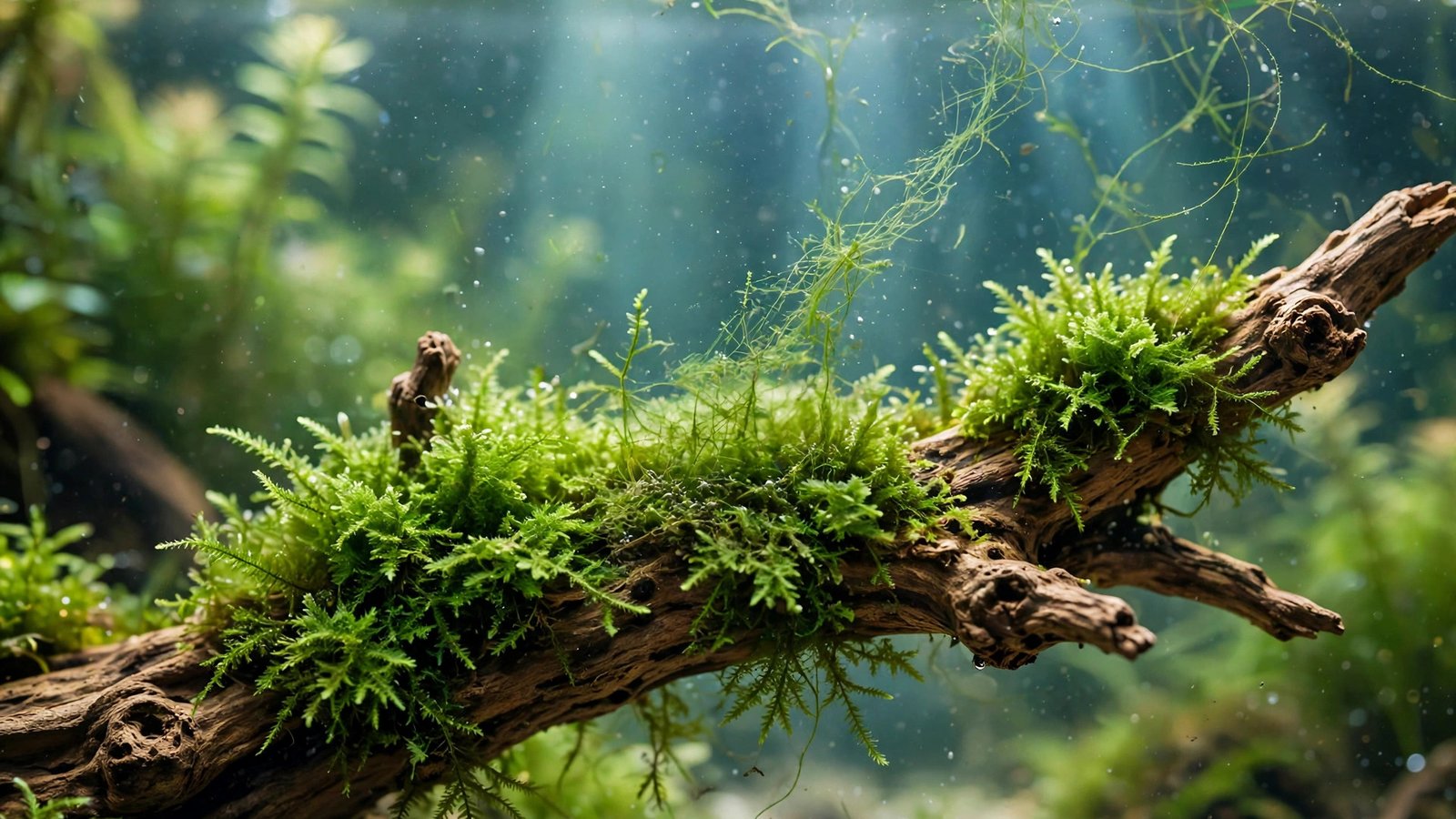
Scrub a leaf of anubias and you get a clean leaf. Scrub java moss and you get a snow globe of shredded fragments drifting around the tank — and the algae still attached. Moss has no leaves to wipe or waxy coating to shrug off scrubbing, so every "just clean it" trick used on other plants fails here. That is exactly why moss turns into algae farms.
The good news: the one cleaning chemical java moss genuinely tolerates is the cheapest bottle on the aquarium shelf — plain 3% hydrogen peroxide. It oxidizes algae, then breaks down into water and oxygen within the hour. Dose it the moss-safe way, because bleach dips and overdoses both end with a dissolved, slimy mat.
Why bleach kills java moss
The standard bleach dip — 1:19 bleach to water for 2 minutes — is tolerated by anubias and java fern, but dip references consistently place all mosses in the "do not bleach" category: moss does not survive it.
The reason is structural. Java moss has no true leaves, no waxy cuticle, and no vascular system — it absorbs everything directly through fine, porous filaments. A chemical that mildly irritates an anubias leaf dissolves moss cells in minutes. Hydrogen peroxide works differently: it oxidizes the thinner algae cells first, then decomposes into plain water and oxygen in 30–60 minutes, which java moss weathers fine. Reach past the bleach bottle, every time.
Method 1: In-tank spot dosing
For moss tied to driftwood, glued to hardscape, or carpeting a corner that can't go into a bucket, spot-dosing is the gold standard. Fill a baby medicine syringe with plain 3% hydrogen peroxide and dose 2 ml per gallon of total tank water volume, squirted slowly directly onto the algae-matted moss.
The classic dose is 2 ml of 3% hydrogen peroxide ★4.7 per gallon — the Dealmed Hydrogen Peroxide 3% USP 16 fl oz bottle is a handy first-aid staple for this job. Peroxide sinks, so aim slightly above the moss and let it settle through. Pause the filter for 20–30 minutes so the dose stays put.
Affiliate disclosure: the product links in this article are affiliate links — if you buy through them, AquaVerdia earns a small commission at no extra cost to you. It keeps the guides free.
Over the next 2–3 days the treated algae shifts from green to pinkish-orange, then white — that color change is the algae dying, not a signal to dose again. Give it a full week. If algae is still green and growing after that, do one more round, but never spot-dose the same patch two days in a row; the moss needs the recovery window.
Method 2: The bucket dip
If your moss is on a stone, mesh tile, or removable piece of wood, the bucket dip is faster and even gentler, since nothing else in the tank sees the chemical. Mix one part 3% hydrogen peroxide with three parts room-temperature water (tank water is ideal) and submerge the moss completely.
Set a timer for 2–3 minutes, maximum — longer dips are for hardy-leaved plants, not moss. Swish gently a few times, then rinse thoroughly in dechlorinated water for several minutes. A little shedding over the next few days is normal; the moss re-establishes.
Which method fits your situation?
| Method | Best for | Time | Risk |
|---|---|---|---|
| In-tank spot dose | Moss glued/tied to hardscape you can't move | 5 min + a week of waiting | Low |
| Bucket dip | Moss on removable stones, tiles, or wood | 10 minutes | Lowest |
| Toothbrush + siphon | Light hair algae, as a pre-step | 10–15 minutes | None |
| Bleach dip | Nothing with moss in it | — | High — kills moss |
Stop the algae coming back
Killing the algae is the easy half — java moss regrows it quickly because its slow growth can't outcompete algae. Fix the conditions:
- Cut the photoperiod to 6–8 hours. Excess light is the top cause of hair algae in moss; a timer ends it.
- Dose leaner. Moss feeds from the water column, so heavy liquid dosing feeds algae first. Halve your dose until the moss is clean.
- Add a cleanup crew. Amano shrimp and Siamese algae eaters graze hair algae out of moss without damaging it.
- Consider liquid carbon. Dosed daily, Seachem Flourish Excel ★4.7 gives plants bioavailable carbon while suppressing regrowth — a popular long-term companion to peroxide treatment.
Moss-safety sources: Aquifarm's bleach-dip guide and Aquarium Genius's peroxide guide.
Frequently asked questions
Will hydrogen peroxide kill my shrimp or fish?
At 2 ml per gallon it is widely reported safe for fish, shrimp, and snails — it breaks down into water and oxygen within an hour. Dose precisely and avoid dosing directly onto livestock; with sensitive animals like crystal shrimp, start at half the dose.
Can I use bleach on java moss if I'm very careful?
Don't. Every plant-dip reference puts all mosses on the never-bleach list, and hobbyists report moss dissolving in even brief, diluted bleach. There is no risk-to-reward case when peroxide is cheaper and safer.
How long until the algae disappears?
It pales to pinkish-white within 2–3 days — that means it is dying. Dead strands get grazed by livestock or decompose over the following week.
Does Seachem Excel kill algae on contact?
No — Excel is a bioavailable carbon source that, dosed daily, suppresses algae growth over weeks. It is the long-term prevention; peroxide is the short-term treatment. The two pair well.