Walk into any planted-tank forum thread about budget lighting and you'll find two NICREW names trading blows: the ClassicLED Plus and the SkyLED Plus. They sit within a few dollars of each other, look nearly identical on a product page, and most buyers pick one based on whichever photo loaded first. That's a coin flip you don't need to take.
These two fixtures genuinely differ in one area that matters to your plants — and agree in nearly every other area. Here's the breakdown, built on manufacturer specs, third-party PAR measurements, and years of owner reports.
Short answer: The NICREW SkyLED Plus ★4.4 is the better buy for planted tanks. It has measurably stronger output (third-party tests put it around 95 µmol·m⁻²·s⁻¹ at 12 inches) and a built-in programmable controller with sunrise/sunset ramping and a moonlight channel. The NICREW ClassicLED Plus ★4.6 costs less and grows low-light plants just fine, but its basic inline controller and weaker output mean you'll hit its ceiling sooner.
How the Spectrum Compares
Photosynthesis cares about wavelengths, not brand names. Both fixtures are built on the same three pillars: 6500K white LEDs for general output, 450nm blue to support compact growth, and true 660nm deep reds — the wavelength chlorophyll absorbs most efficiently. The ClassicLED Plus adds green LEDs to the mix and advertises a CRI of 91, which shows up in practice as slightly more natural-looking fish colors and greener-looking foliage.
The SkyLED Plus takes the RGB-instead-of-blue approach that forum veterans have praised for years: its red and green diodes give plants a more natural coloration than the white-plus-blue-only lights it replaced. In side-by-side use, hobbyists describe the difference between the two mostly as a matter of rendering — the ClassicLED Plus looks a touch fuller to the human eye — rather than a growth difference. Spectrum alone doesn't decide this matchup.
PAR and What Each Light Actually Grows
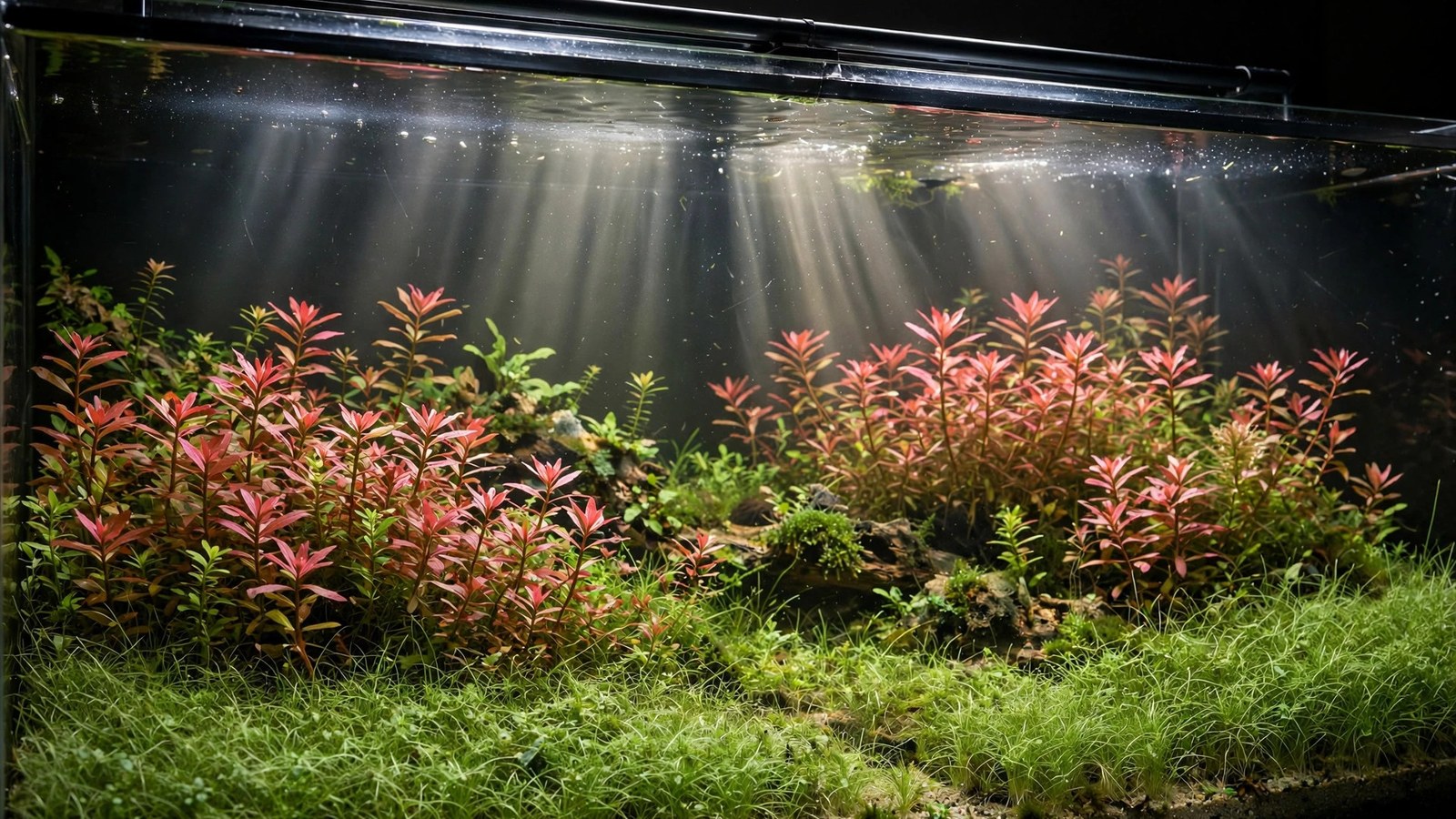
Watts don't tell you what grows; PAR does. Third-party PAR testing puts the SkyLED Plus around 95 µmol·m⁻²·s⁻¹ at 12 inches (measured in air — expect less once water and a glass lid are in the path). That lands it squarely in the territory that grows most easy plants plus a respectable list of medium-light species: Ludwigia repens will blush, dwarf sagittaria spreads, and shallow-tank carpets of Monte Carlo are genuinely achievable with CO2 and a lean dosing routine. In tanks deeper than about 18 inches, demanding carpeters and deep reds still run out of light.
NICREW publishes no PAR figure for the ClassicLED Plus, and owner experience consistently describes the same pattern: it grows Java fern, Anubias, mosses, and most crypts reliably, and handles some medium-demand species in shallow tanks under about 14 inches of depth. Below that depth the output falls off quickly — don't expect carpeting plants or persistent red stems from it. If your plant list ends at "low light," its output is genuinely sufficient; if your list is growing, its ceiling arrives fast.
Controls, Timer, and Ramp — The Real Deciding Factor
This is where the two fixtures stop looking alike. The SkyLED Plus ships with a wired backlit LCD controller that programs on/off times, ramps brightness up and down over 15 or 30 minutes (up to 120 minutes on the 2.0 revision), and runs a moonlight channel — blue LEDs at low output — after lights-out. It comes pre-programmed with a default day cycle, so it works sensibly out of the box and gets better once you customize it. Dual-channel dimming lets you set the white/red and blue channels independently from 0 to 100 percent.
The ClassicLED Plus uses a far simpler inline controller: buttons dim the white channel (which includes the red and green diodes) and the blue channel separately, and the fixture remembers your setting when power is cut. That memory is what makes a plug-in wall timer a workable solution — the light returns to your chosen levels when the timer switches on. It works, but you get no ramp, no moonlight mode, and the abrupt on/off. For fish-only or very easy planted tanks that's fine; for a scape you're proud of, the sunrise fade is a real quality-of-life upgrade.
Build, Sizes, and Fit
Both fixtures use aluminum alloy housings with adjustable docking brackets that fit rimmed and rimless tanks, and both are sold in a wide spread of sizes covering roughly 12 to 60 inches. The SkyLED Plus 2.0 revision is fully sealed against splashes and humidity, while the ClassicLED Plus's aluminum shell handles normal splash duty but appreciates a glass or acrylic canopy overhead — good practice for any budget fixture. Neither has app control, which keeps the price down and removes the most common failure point on budget lights.
One practical note from long-term owners: the ClassicLED Plus has scattered reports of individual white diodes failing after six to twelve months of daily use, and NICREW's customer service has a good reputation for replacing affected units. Keep the receipt.
Side-by-Side Comparison
| Feature | ClassicLED Plus | SkyLED Plus |
|---|---|---|
| Spectrum | 6500K white, 450nm blue, 660nm red, green LEDs; CRI 91 | 6500K white, 450nm blue, 660nm red |
| Measured output | Not published; low-light capable, weak at depth | ~95 PAR at 12″ in air (third-party) |
| Timer | None built in — works with a plug-in wall timer | Built-in programmable LCD controller |
| Sunrise/sunset ramp | No | Yes — 15 or 30 minutes (up to 120 on 2.0) |
| Moonlight channel | No | Yes — dim blue after lights-out |
| Dimming | Inline buttons, two channels | Dual channel, 0–100% via controller |
| Water resistance | Splash-tolerant aluminum | Sealed housing on the 2.0 revision |
| Best for | Low-tech tanks, low-light plants | Low-to-medium light plants, future-proofing |
Which One Should You Buy?
Buy the NICREW ClassicLED Plus ★4.6 if your plant list is genuinely settled at the easy end — Java fern, Anubias, mosses, crypts — and you want the cheapest fixture that grows them reliably. It's a proven workhorse in that role, and pairing it with a simple plug-in timer removes its biggest weakness.
Buy the NICREW SkyLED Plus ★4.4 if there's any chance your scape ambitions grow — stems that color up, a foreground carpet attempt, or a deeper tank. The built-in controller alone justifies the small step up: programmed ramps, a moonlight channel, and per-channel dimming are features you'd otherwise pay much more to get.
Affiliate disclosure: the product links in this article are Amazon affiliate links. If you buy through them, AquaVerdia earns a small commission at no extra cost to you — it keeps the lights on, literally.
If you're still deciding between brands rather than within the NICREW lineup, our hygger vs NICREW comparison covers the wider budget field, and our low-tech planted tank light roundup shows where both of these sit among the alternatives.
Frequently Asked Questions
Can the ClassicLED Plus grow carpet plants?
It struggles. In a shallow tank with CO2, slow-growing carpets like Monte Carlo are possible, but growth is thin and slow compared to stronger fixtures. For reliable carpeting, the SkyLED Plus's higher output is the safer budget choice.
Is the SkyLED Plus controller hard to program?
No — it's a one-time setup on a backlit LCD with simple button menus. Set your on/off times, pick a ramp length, and it runs itself. Most owners program it once and never touch it again.
Do I need a separate timer with the ClassicLED Plus?
Yes, for consistent photoperiods — aim for 8 to 10 hours daily. The ClassicLED Plus remembers your dimmer setting when power cycles, so a plug-in wall timer works fine with it.
Which light is better for red aquarium plants?
The SkyLED Plus. Red coloration in plants like Ludwigia and Rotala is driven by strong light with 660nm reds; the SkyLED Plus's higher PAR gives it a clear edge, while the ClassicLED Plus keeps most reds green at depth.