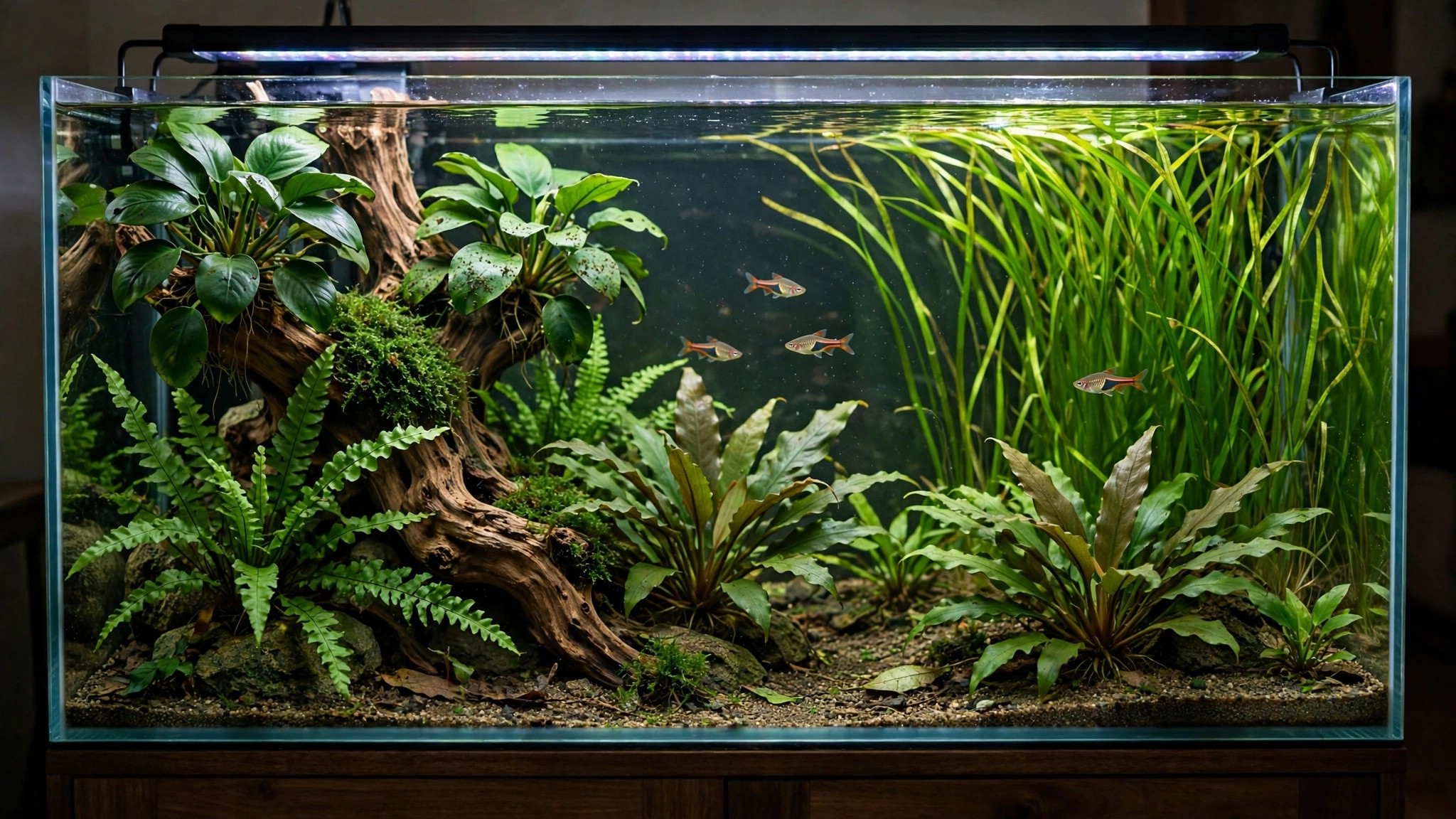
The most expensive mistake in a first planted tank is buying a pressurised CO2 system before you know whether your plants need it, then turning the light up to match and watching algae take over.
Low-tech tanks work on a different deal: slower growth, in exchange for far less equipment and a tank that forgives a missed water change. Whether it suits you depends on the plants you want, not on what the shop is selling.
What low-tech actually means
Low-tech is not a synonym for neglected. It means growth limited by design: moderate light, no injected CO2, simple fertilisation. Growth is slower, but there is no cylinder to run out overnight.
It does not mean no care. You still need a cycled filter, regular water changes, and plant food. What you skip is intense light, daily dosing, weekly trimming.
Where a low-tech tank gets its carbon
A tank without injection is not carbon-free. CO2 dissolves from the air at the surface, fish breathe it out, and bacteria release it as they break down waste. A gently rippling surface exchanges gas well; a still surface can starve the water below of oxygen and CO2.
The catch is quantity. An un-injected tank holds only a few milligrams of CO2 per litre, far below an injected tank. Tropica's plant database puts medium demand at 6–14 mg/L and high demand at 15–25 mg/L — both above what low-tech tanks provide. Easy plants evolved for the low end; demanding plants did not. Check any species there before buying.
Plants that thrive without injected CO2
Pick from this group and your tank will look planted within weeks. All tolerate moderate light, and most need only monthly trimming.
| Plant | Why it works without CO2 | Watch out for |
|---|---|---|
| Anubias | Slow grower; low carbon demand | Algae under bright light |
| Java fern | Feeds from the water column | Black spots are usually plantlets |
| Cryptocoryne wendtii | Root feeder that spreads steadily | Melts after replanting, then regrows |
| Vallisneria | Fast runner even at low CO2 | Can take over a small tank |
| Dwarf sagittaria | Low carpet that spreads by runners | Needs root feeding in inert substrate |
| Water sprite | Fast grower that soaks up nutrients | Shades plants below |
Feed these plants lightly: a lean liquid fertiliser once a week, raised only if new growth looks pale after a few weeks. As an Amazon Associate, I earn from qualifying purchases through the links here. A gentle liquid such as Seachem Flourish ★4.7 suits this tank: start at half the label dose for the first month, then judge by the plants.
The light trap that breaks low-tech tanks
Here is the failure pattern, and it looks like a CO2 shortage when it is not. A keeper buys a powerful light, runs it ten hours a day, and watches algae arrive within weeks: plants cannot use that much light without more carbon, so the extra energy feeds algae. CO2 fixes this — but only by raising the ceiling to match a light level the tank never needed.
The cheaper fix is to lower the ceiling: keep the photoperiod at 6–8 hours, and choose a light sized for a low-tech tank rather than the brightest unit that fits the rim. A simple full-spectrum LED such as the NICREW ClassicLED Plus ★4.6 gives even, moderate light, and its dimming lets you start low and raise it only when growth shows it can keep up.
Watch the tank for two weeks after any light change. If algae coats slow leaves like Anubias, the light is still too strong — dim it first.
When added CO2 is actually worth it
CO2 earns its keep in three situations: when your plant list includes species that genuinely need it, such as dense carpets or red stems; when you want speed, for a show tank filled in weeks; and when you already run strong light and want plants, not algae, to use it.
It is not worth it as insurance. A system added to a tank of Anubias and crypts will make them grow a little faster, at the cost of a cylinder, a regulator, and weekly checks. Worse, unstable CO2 — a yeast bottle fading over three weeks, or a cylinder running out mid-week — causes more algae than no CO2 at all. Add it steadily, or not at all.
Tick two or more and start researching a system; tick none and spend the money on plants instead.
- You want a dense carpet or a red-dominated scape.
- You run strong light and algae keeps winning.
- You will check a drop checker weekly.
- You accept weekly trimming instead of monthly.
Low-tech is not a compromise you suffer until you can afford CO2. Choose the plants first, match the light to them, and let CO2 be a decision your scape makes for you — not a purchase you make on day one.
Frequently asked questions
Will my plants die without CO2?
No, provided you choose easy species and keep light moderate. Slow growth here is normal, not failure. Plants that melt or stall are usually short of light or nutrients — check those before blaming carbon.
Can I add CO2 later to a low-tech tank?
Yes, and it is often the best order: start low-tech, learn your tank, then add CO2 when a specific goal needs it. Raise light gradually, and expect more trimming as plants adjust.
Does liquid carbon replace CO2 injection?
Not really. Liquid carbon supplies a small amount of usable carbon, but it does not raise dissolved CO2 like injection, nor turn a demanding plant into an easy one. Keep it away from Vallisneria, which some keepers report melting after dosing.
Do floating plants help a low-tech tank?
Yes, with one condition. Floaters such as frogbit take CO2 straight from the air, grow fast, and pull excess nutrients from the water, starving algae. Keep them corralled, or they will shade the plants below.