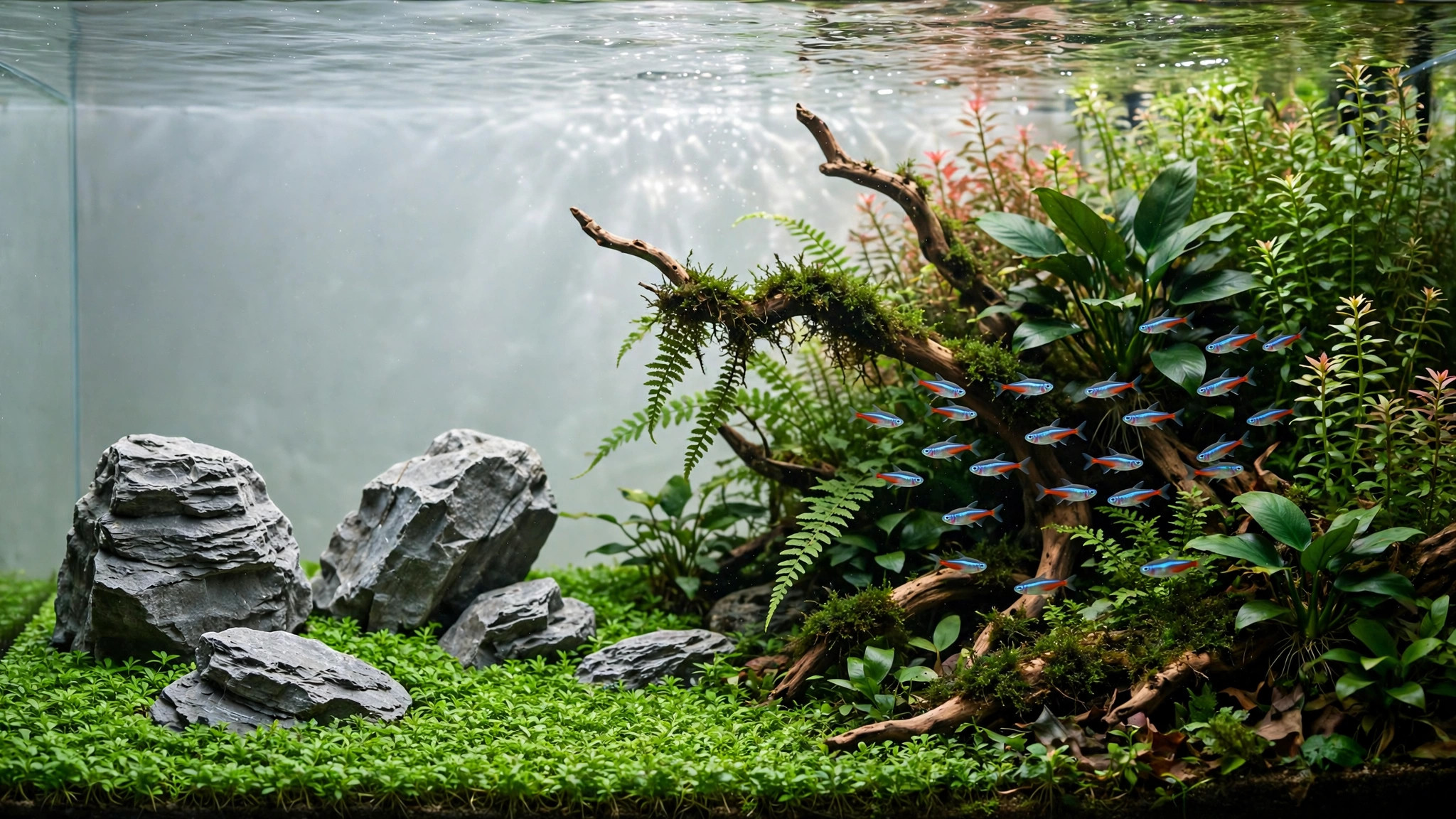
Three stones and a lawn of green look like the easiest aquarium you could build. That is exactly why Iwagumi traps beginners. The photograph hides the pressurised CO2, high light, and weekly trimming behind the effortless look. Remove any one of those and the composition falls apart in plain sight, because nothing else hides behind.
Nature Aquarium style looks busier, yet the beginner version is far more forgiving. Driftwood dressed with Anubias, Java fern, and moss looks finished on day one. This guide compares the two styles honestly, so you pick the one your skills can support.
Short answer: For a beginner, Nature Aquarium style is easier than Iwagumi. A low-tech Nature layout built on epiphytes attached to wood needs no CO2, tolerates moderate light, and hides mistakes behind dense planting. Iwagumi is harder: its single carpet must be perfect, needing high light, pressurised CO2, and regular trimming, and any algae or bare patch ruins the look.
What Each Style Actually Is
Iwagumi is a minimalist Japanese style built around stones. An odd number of rocks — usually three, five, or seven, all the same type — forms the composition, with one dominant stone placed off-centre. A single carpeting plant, such as Monte Carlo or dwarf hairgrass, covers the substrate in one unbroken lawn. The stones are the scape; the carpet is the frame.
Nature Aquarium style, popularised by Takashi Amano, recreates a landscape: a forest floor or a riverbank. Driftwood and stone create the structure, plants layer into foreground, midground, and background, and open space creates depth. For beginners, Nature Aquarium is a broad family, not one recipe. A contest tank with a dense carpet is one end of it; a wood-and-epiphyte layout with Anubias, Java fern, crypts, and moss is the other. Only the second end is beginner-friendly, and it is the version recommended here.
Why Iwagumi Punishes Beginners
The first problem is the carpet. Carpeting plants grow low and dense only when light, CO2, and nutrients are abundant and stable. Without pressurised CO2, most carpets grow thin and patchy — and a patchy carpet is the entire foreground. Aim for roughly 30 ppm of dissolved CO2, judged by a lime-green drop checker, and keep it steady: fluctuating CO2 is a fast route to algae, and exposed substrate gives algae nowhere to hide.
The second problem is trimming with no margin for error. A carpet needs cutting before it lifts and shades itself out, and cutting a lawn evenly takes practice. Long scissors reach across the tank without disturbing the stones, which is why a dedicated kit earns its place: the hygger 6-in-1 Long Aquarium Aquascaping Tools Kit ★4.6 covers tweezers, curved scissors, and a spatula. Trim little and often, and siphon clippings out the same day.
The third problem is composition: symmetrical stones look staged and a dominant stone placed dead centre kills movement. The 2HR Aquarist Iwagumi setup guide is a good reality check on the CO2 and trimming commitment before you commit.
Why Beginner Nature Aquarium Forgives
A beginner Nature layout starts with the hardscape doing the heavy lifting. One strong piece of driftwood, positioned diagonally, reads as a landscape before a single plant goes in. Attach Anubias, Java fern, and Bucephalandra to the wood and the composition is finished on planting day. A fern frond covers a misplaced stone; uneven moss reads as texture, not a mistake.
Epiphytes are why this version works without CO2. Anubias, Java fern, and Bucephalandra feed from the water column, grow slowly, and tolerate 20 to 40 PAR. Slow growth means less trimming and fewer imbalances for algae to exploit. Attach rhizomes to wood or stone with gel glue — never bury the rhizome — using an aquarium-safe gel such as Seachem Flourish Glue ★4.7, keeping glue off the growing tip.
Affiliate disclosure: Amazon links on this page may earn AquaVerdia a small commission at no extra cost to you.
Dense planting is the other forgiving trait. Crypts, easy stems, and moss on the wood outcompete algae, and bare patches do not matter when the eye follows wood and foliage instead of an empty lawn. Run the light 6 to 8 hours a day at first, change 30 to 50 percent of the water weekly, and add Amano shrimp and nerite snails once cycled. The Aquarium Lesson Nature Aquarium guide covers layout types and plant roles in more depth.
Head-to-Head Comparison
| Factor | Iwagumi | Nature Aquarium (beginner) |
|---|---|---|
| CO2 | Pressurised, about 30 ppm | Optional |
| Light | High and uniform | Low to moderate |
| Plant species | Usually one carpet | Five or more |
| Trimming | Frequent, even carpet trims | Occasional stem and moss trims |
| Algae visibility | Very high | Lower — dense planting hides it |
| Mistake tolerance | Almost none | High |
Which Should You Build First?
Build the beginner Nature Aquarium first. Start with a 60 cm tank if you can: long enough for real depth and far easier to light evenly than a tall, narrow tank. Slope aquasoil toward the back, set one diagonal piece of driftwood, attach your epiphytes, add crypts and moss, and plant a few background stems. Stock lightly once cycled, and give the layout two to three months to settle.
Attempt Iwagumi when you can keep a planted tank algae-free for three months, you own pressurised CO2 with a solenoid timer, and you are happy trimming weekly. Even then, start with dwarf hairgrass or Monte Carlo rather than dwarf baby tears. Nature teaches stability and patience; Iwagumi then tests both under a spotlight.
FAQ
Can you build an Iwagumi without CO2?
You can try, but most carpets will not fill in densely without it. Dwarf hairgrass and Monte Carlo are the most forgiving candidates, and even they grow patchily without CO2.
Can a Nature Aquarium be low-tech?
Yes — the beginner version here is designed for it. Anubias, Java fern, Bucephalandra, crypts, and mosses all grow without CO2 under low to moderate light.
Which style is cheaper for a first tank?
The beginner Nature layout is usually cheaper. It needs no CO2 system and no high-output light. Iwagumi adds CO2 equipment, stronger lighting, and nutrient-rich substrate.
Which style is better for shrimp?
Nature Aquarium, by a clear margin. Moss, wood, and dense foliage give shrimp grazing surfaces and shelter. An Iwagumi offers open carpet and little cover, so shrimp stay hidden.