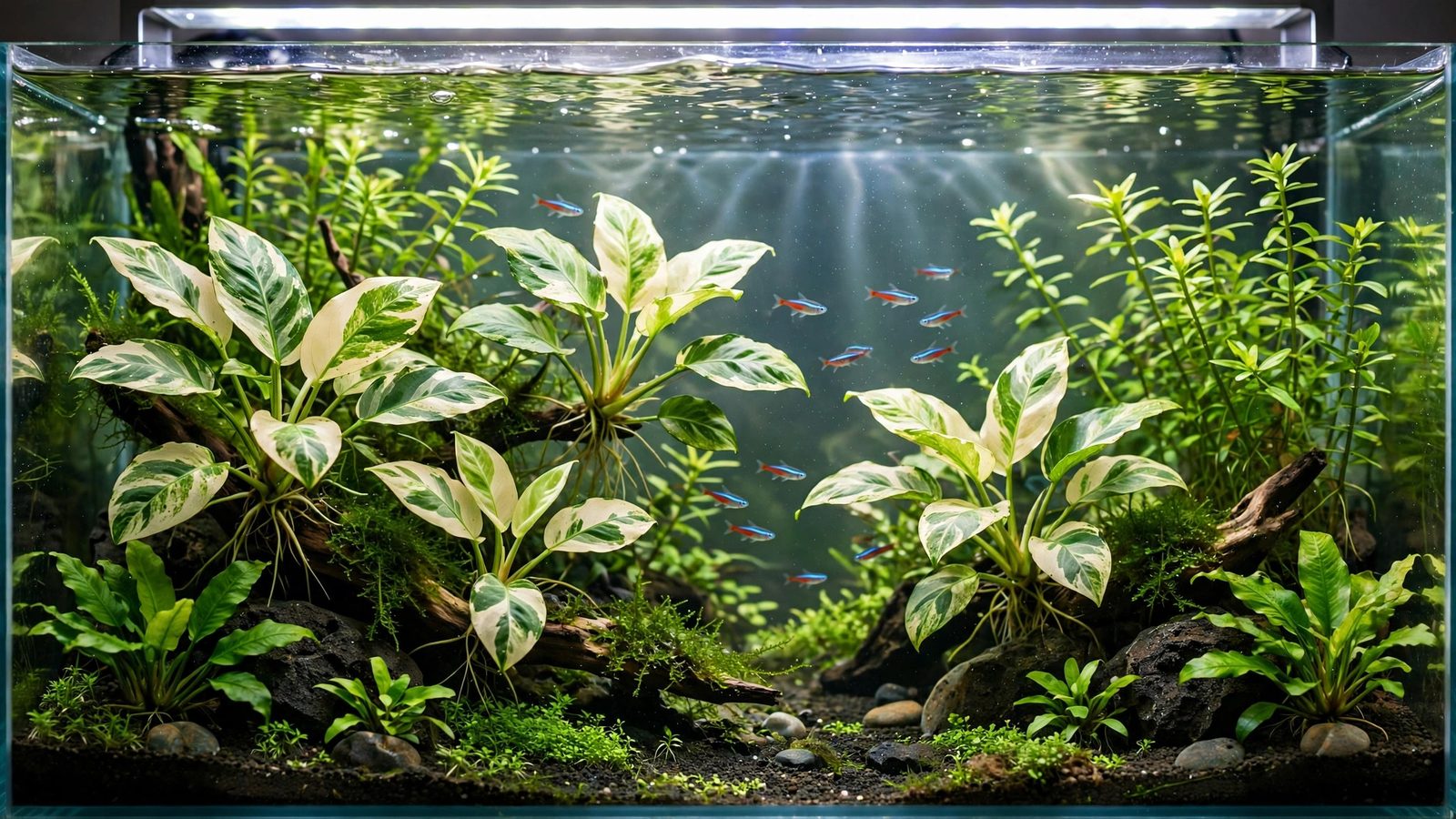
Variegated aquarium plants — leaves patterned in white, cream, pink, or yellow against green — are the collector's corner of the hobby. They're rare, often expensive, sometimes finicky, and absolutely magnetic: a variegated anubias in a sea of green stops every visitor mid-sentence. These 6 variegated aquarium plants are worth the hunt, with honest guidance on finding them, keeping the variegation stable, and not getting scammed.
What Variegation Is (and Why It's Rare)
Variegation is a mutation that reduces chlorophyll in patches of the leaf — white or yellow sectors where green should be. In nature it's a disadvantage (less photosynthesis), so variegated plants are usually nursery-propagated sports or tissue-culture selections, produced in small numbers. That scarcity plus high demand equals high prices and frequent mislabeling.
The critical concept: variegation stability. Some variegated plants hold their patterns reliably (variegated anubias); others revert — new growth comes in solid green, and the variegation fades over months. Reversion is the heartbreak of variegated collecting. The plants below are selected for reasonable stability, with reversion risks noted honestly.
Keeping Variegation Stable
Give them strong light
Variegated leaves photosynthesize less efficiently (less chlorophyll), so they need more light than their green counterparts to thrive — and strong light also intensifies the contrast. A variegated plant in dim light grows slowly, reverts faster, and looks washed out. Bright, not blasting. Pair variegated specimens with our purple plant picks and rosette plant collection for a color-blocked aquascape — variegation photographs best against deep reds and purples. Check light requirements per species in Tropica's plant database.
Prune reversions immediately
When a stem or leaf comes in solid green, remove it promptly — green growth is more vigorous and will outcompete the variegated portions, eventually taking over the plant. Ruthless pruning of reversions is how collectors maintain variegation for years. Don't feel guilty; it's the plant's nature to revert, and your job to select against it.
Propagate from the best parts
When propagating (dividing rhizomes, taking cuttings), always use the most strongly variegated portions. Variegation strength is partially heritable in vegetative propagation — start new plants from the best-patterned growth and the line stays strong. This is how nurseries maintain their stock.
6 Variegated Plants Worth the Hunt
1. Anubias barteri var. nana 'Pinto' / 'White'
The king of variegated aquarium plants. Anubias 'Pinto' has marbled white-green leaves — each leaf uniquely patterned like marble — on the bulletproof anubias nana frame. It's slow (even by anubias standards), expensive, and absolutely stunning. Stability is good: established plants hold variegation well, though new leaves sometimes emerge greener before whitening. The centerpiece of any collector's hardscape. Care is standard anubias per our epiphyte guide — attach, shade lightly, be patient.
2. Anubias 'Stardust'
A newer variegated anubias with speckled white-gold variegation — like stars scattered across green leaves. Slightly faster-growing than 'Pinto' and (marginally) more available, with good stability. The speckled pattern reads beautifully at midground scale, where 'Pinto's marbling can look busy. Another attach-and-wait epiphyte — variegation rewards the patient.
3. Echinodorus 'Ozelot' (variegated spotting)
Strictly speaking, 'Ozelot' is spotted rather than variegated — dark red-brown spots and mottling on green leaves — but it delivers the variegated visual effect in a tough, affordable, readily available package. It's the "variegated look" for non-collectors: all the visual interest, none of the price or reversion anxiety. A single specimen anchors a midground with pattern no green plant can match. See our sword comparison for its relatives.
4. Cryptocoryne wendtii 'Florida Sunset' / pink-variegated forms
Pink-variegated crypts — leaves marbled in pink, cream, and green — are among the most sought-after aquarium plants in existence. They're tissue-culture rarities with real reversion risk (crypts revert readily) and slow growth, making established specimens genuinely precious. If you find one, buy it; if you keep its variegation for a year, you've earned collector status. Not a beginner plant — this is the deep end.
5. Hygrophila 'Chai' / variegated hygro
Variegated stem plants are the most practical variegation — fast-growing, so you get visual impact quickly, and easy to propagate from the best cuttings. Variegated hygrophila (cream-white marbled leaves) grows like its green cousin but with the collector's pattern. Higher reversion risk than anubias (fast growth = faster reversion takeover), so prune green shoots religiously. The best variegated plant for impatient collectors.
6. Rotala 'White' / pale variegated rotala
Pale and white rotala forms — whether true variegation or pigment mutations — create ghostly white-pink stems that glow against green backgrounds. They're demanding (strong light, CO2, stable conditions — white leaves are fragile) but unmatched as accent plants. Use sparingly: a small ghostly cluster at a focal point, surrounded by deep green. Less is everything with this one.
Buying Variegated Plants Without Getting Burned
Buy from reputable specialists
Variegated plants are the most mislabeled segment in the hobby — green plants sold as variegated, tissue-culture cups with one variegated leaf among green, photos that don't match the plant. Buy from established aquatic-plant specialists with review histories, not random marketplace sellers. Ask for photos of the actual plant, not stock images.
Understand the price
Real variegated anubias costs 10–50x the green version — that's the market for genuine rarity, not a scam (though scams exist at every price). If a "variegated" plant is suspiciously cheap, it's probably mislabeled. Research going rates before buying; the collector community discusses prices openly.
Quarantine and inspect
Expensive plants deserve quarantine — a $100 anubias carrying algae or pests into your display tank is a special kind of pain. Inspect on arrival: variegation should be visible on multiple leaves, the rhizome firm, roots healthy. Tissue-culture cups are the safest format (sterile, pest-free); compare formats in our tissue culture vs potted guide.
Growing Variegated Plants Emersed
Many collectors grow variegated anubias and crypts emersed — in humid terrarium-style setups — and there are good reasons. Emersed growth is faster (unlimited CO2), variegation often shows more strongly in air-grown leaves, and you can propagate and trade without disturbing an aquarium. A simple setup — a clear storage tub with a few inches of water, a humidity dome or cling-film cover, and a decent light — grows variegated anubias beautifully. Keep humidity above 80% and the rhizomes moist but not submerged. The transition back to submerged growth causes some melt, so grow out more than you need and select the best-patterned portions for the aquarium. For rare varieties like pink crypts, emersed culture is also insurance — a backup colony safe from any aquarium disaster.
A reliable pick here is precision aquascaping tools.
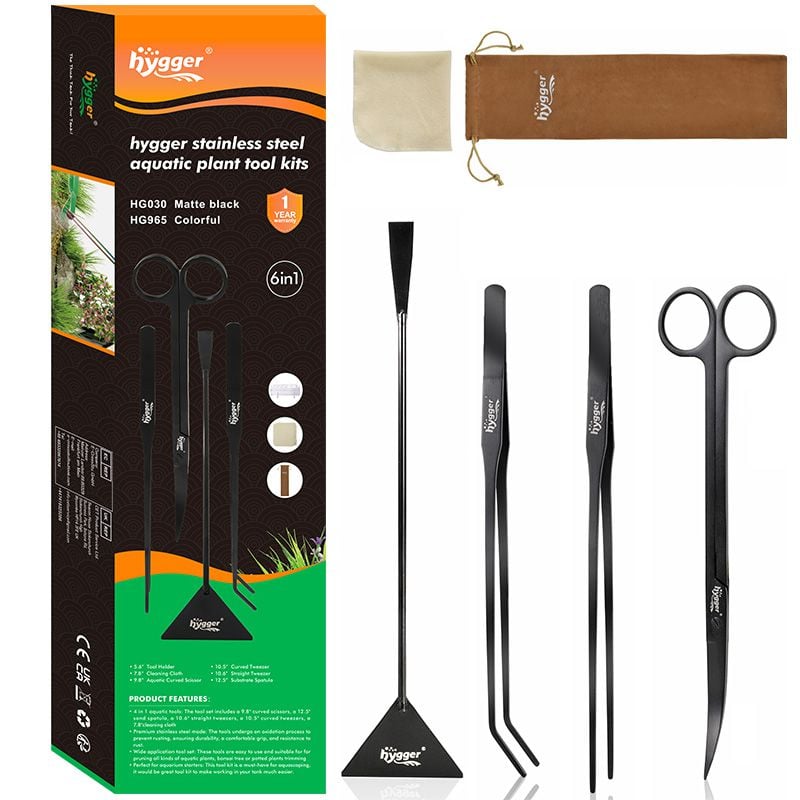 ★4.6
hygger 6-in-1 Long Aquarium Aquascaping Tools Kit
Check Price on Amazon ★4.6A reliable pick here is Seachem Flourish.
Frequently Asked Questions
Why is my variegated plant turning green?
Reversion — the plant's natural tendency to return to full chlorophyll production. It's accelerated by low light (the plant "wants" more green to photosynthesize) and by letting green shoots grow unchecked. Increase light, prune every green shoot immediately, and propagate only from variegated portions. Some reversion is inevitable; management keeps it minimal.
Do variegated plants need special fertilizer?
No special products — but they benefit from complete, consistent nutrition more than green plants do, since they're already photosynthetically handicapped. Iron and magnesium (chlorophyll components) matter; deficiencies show faster in variegated leaves. Dose a quality all-in-one regularly and don't let them go hungry.
Can I create variegation myself?
Not reliably — variegation is a random mutation. What you can do is select: if a green plant throws a variegated sport (it happens), isolate and propagate that portion aggressively. Most commercial variegated varieties started exactly this way — a sharp-eyed grower noticing one odd leaf. Check your plants; you might get lucky.
Are variegated plants harder to keep alive?
Somewhat — less chlorophyll means less energy, so they're slower-growing and less forgiving of neglect than their green counterparts. But a variegated anubias is still an anubias: tougher than most green stems. The difficulty is in maintaining the pattern (pruning reversions), not in keeping the plant alive.
What's a fair price for variegated anubias?
It varies wildly by variety, size, and market — 'Pinto' typically runs many times the price of green nana, with larger specimens commanding premiums. Prices drop as tissue-culture labs scale up production of popular varieties. Check multiple specialist sellers, be wary of deals that seem too good, and remember: the cheapest variegated plant is often the most expensive mistake.
Will variegation show in low-tech tanks?
The pattern shows regardless of tech level — variegation is genetic, not conditional. But low light weakens contrast and accelerates reversion, so variegated plants look their best with at least moderate light. Anubias 'Pinto' in a low-tech tank is still visibly marbled; it just grows slower and needs more vigilant reversion pruning.
How do I display variegated plants for maximum impact?
Variegation pops against dark backgrounds and deep-green neighbors — place your variegated specimen where the eye lands naturally, typically at a golden-ratio focal point, with plain green plants behind it. Avoid surrounding it with other patterned or colorful plants; visual competition dilutes the effect. A single variegated anubias on dark driftwood against a black background is worth more visually than three scattered among red stems. Spotlight it with slightly stronger light than its neighbors (a small focused LED works) to intensify the white-cream contrast.
Hunt Well
Variegated plants are the hobby's treasure hunt — rare, pricy, occasionally heartbreaking, and utterly captivating. Start with 'Ozelot' for the look without the risk, graduate to variegated hygro for fast impact, and save the 'Pinto' purchase for when you've got a stable tank and the patience its slow marbled leaves demand. The hunt is half the fun; the plant is the trophy.