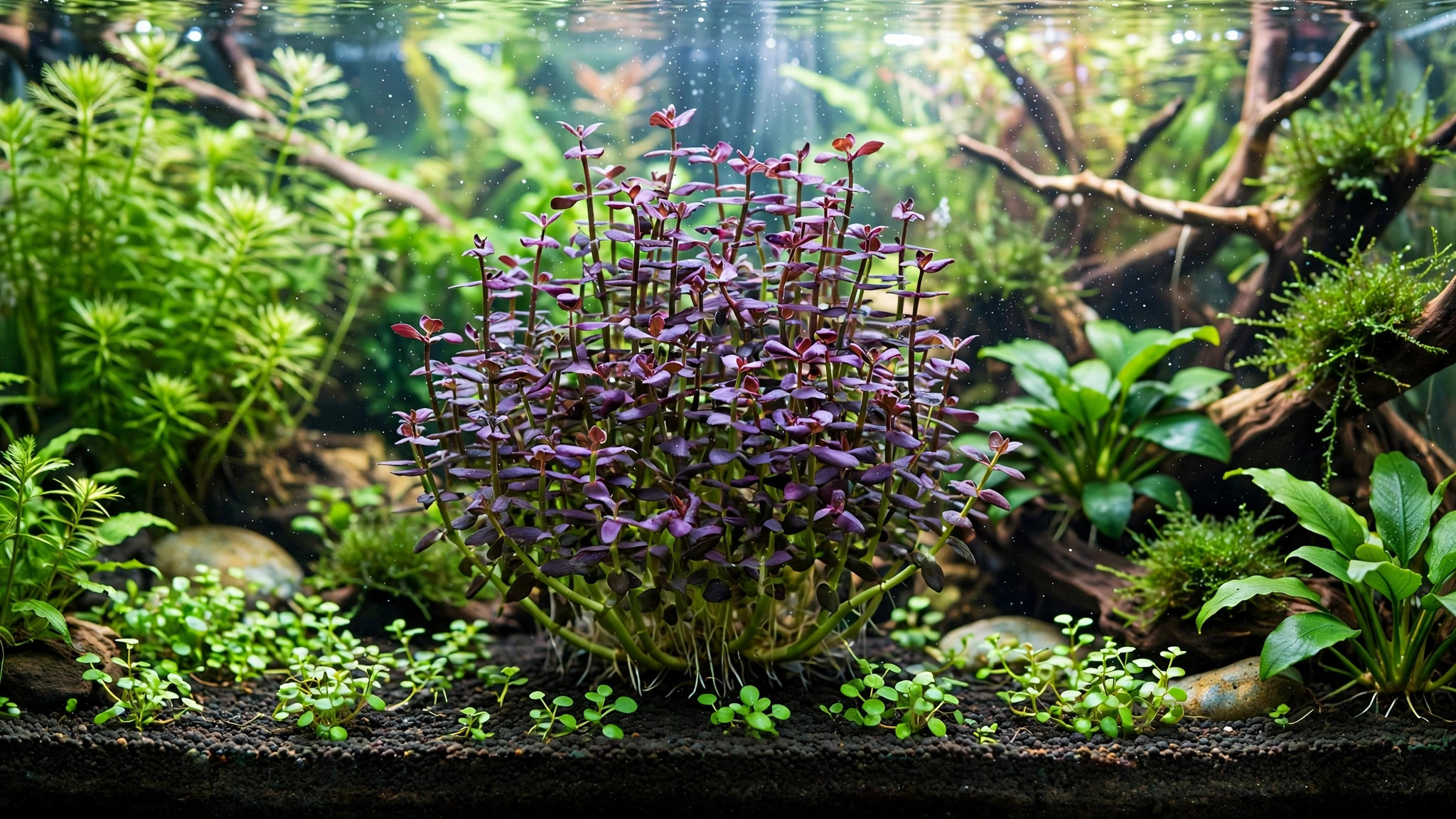
Buy the purple form, plant it in a bright tank, and watch it turn green. That is the most common disappointment with Bacopa salzmannii ‘Purple’, and it is rarely a faulty plant. The colour is a response to conditions, not a fixed trait: give it strong light, steady carbon dioxide, and complete fertilisation, and the same stems deepen to dark red-purple. Starve it of any one of those, and it quietly reverts to green-bronze.
This guide separates the purple form from its greener relatives, sets out the conditions that hold the colour, and covers planting, trimming, and the faults that undo it. It is a moderate-demand stem plant, not a plant that colours itself, but it is far less demanding than the red stems it is often sold beside.
Purple vs green forms
Bacopa salzmannii comes in several colour forms, from green with a hint of purple through to the deep purple form sold as ‘Purple’. Grown side by side under identical light, the difference is stark: the purple form stays dark even down the stem, while the greener form stays green-bronze. It is distinct from Bacopa caroliniana ‘Colorata’, which has larger leaves and a tougher constitution. Salzmannii is smaller and pickier, with small oval submerged leaves up to about 2.2 cm long on a thick, light-green stem with darker veins.
Light and CO2: the purple formula
Colour tracks light intensity more than any fertiliser. Place it in a bright, unshaded spot and aim for roughly 150 µmol of PAR at its leaves. Below that, expect bronze-green growth. If your light cannot reach that level, upgrading it does more than any dosing change; a full-spectrum fixture such as the NICREW ClassicLED Plus ★4.6 is a practical step for tanks in the 24 to 30 inch range.
CO2 is where sellers disagree, because both sides are partly right. The plant survives without injected CO2 and will grow green and healthy in a low-tech tank. But injected CO2 unlocks the deep purple, because carbon makes up roughly half of a plant’s dry mass. Fading colour in a high-tech tank is a reliable early sign that CO2 has dropped.
Water and fertiliser
Unlike hardy B. caroliniana, salzmannii is picky about hardness. It grows in pH 6.0–7.5 and 2–15 dGH, but does much better in soft water with KH below 4 dKH. If your tap water is hard and alkaline, aquasoil that buffers KH down, plus remineralised RO water for changes, will help most. Keep parameters stable; swings cause more melt than a slightly imperfect but steady value.
Feed it from the water column. A weekly dose of a complete liquid such as Seachem Flourish ★4.7 covers the micronutrient base in a lightly stocked tank; in high-light tanks, add macros (nitrogen, phosphorus, potassium) on top. Curled new leaves point to a fertiliser gap, not a lighting problem.
Disclosure: some links in this article are affiliate links. As an Amazon Associate, AquaVerdia earns from qualifying purchases, at no extra cost to you. Only products that fit this article’s conditions are linked.
Planting and placement
Plant it as a midground group. Space stems about 2–3 cm apart so light reaches the lower leaves; a tight bunch shades its own base and goes bare. For tissue-culture cups, wash the gel off the roots before splitting the portion. For bunched stems, remove any lead weight and strip the lowest leaves.
Push stems 3–5 cm into nutrient-rich aquasoil with pinsettes. Root tabs placed near the group give a slow backup supply, for example Seachem Flourish Tabs ★4.2 pushed into the substrate beside the stems. Avoid deep shade and dense floating-plant mats.
| Plant | Colour under strong light + CO2 | Water preference | Height |
|---|---|---|---|
| B. salzmannii ‘Purple’ | Deep red-purple, down the stem | Soft, KH below 4 dKH | 20–30 cm |
| B. salzmannii (green form) | Green-bronze, purple hint | Soft, KH below 4 dKH | 20–30 cm |
| B. caroliniana | Bronze-pink tones | Tolerant of harder water | Up to about 60 cm |
Trimming and propagation
Cut the stem top above a node, then replant it; the cut base throws out side shoots, and the top roots within a couple of weeks. Keep the stand below about 25 cm: beyond roughly 30 cm the lower portion tends to go bare. Replanting tops into gaps thickens a group.
Troubleshooting
Staying green. Check light first, CO2 second, nutrients third, in that order. A plant in shade, or with CO2 that has quietly dropped, will not colour no matter how much iron you add. Also confirm you actually have the purple form: green-form stock sold loosely as “purple” is a common mix-up.
Bare lower stems. Thin the group, trim the tops back, and replant them in front of the bare bases.
Melting after planting. Transition melt is normal in the first two to three weeks. Leave firm stems in place; remove only soft, mushy ones. Sources: the 2Hr Aquarist guide and Flowgrow database entry.
FAQs
Does Bacopa salzmannii ‘Purple’ need CO2?
Not for survival, but yes for its best colour. Without CO2 it stays green; with steady CO2 and strong light it turns deep purple.
Why is my purple Bacopa turning green?
Almost always light or CO2: too little PAR at the plant, shading by other plants, or a CO2 supply that has dropped. Check those before changing fertiliser, and judge only new growth, which takes two to three weeks to show the change.
How tall does it grow, and where should it go?
About 20–30 cm: a midground plant. Trim before 25 cm to keep lower stems leafy.
Can beginners grow Bacopa salzmannii ‘Purple’?
Yes, if the tank is stable and the light is adequate. It is rated easy to moderate, but beginners should expect green growth until light, CO2, and fertilisation are all in place; the purple is earned, not automatic.