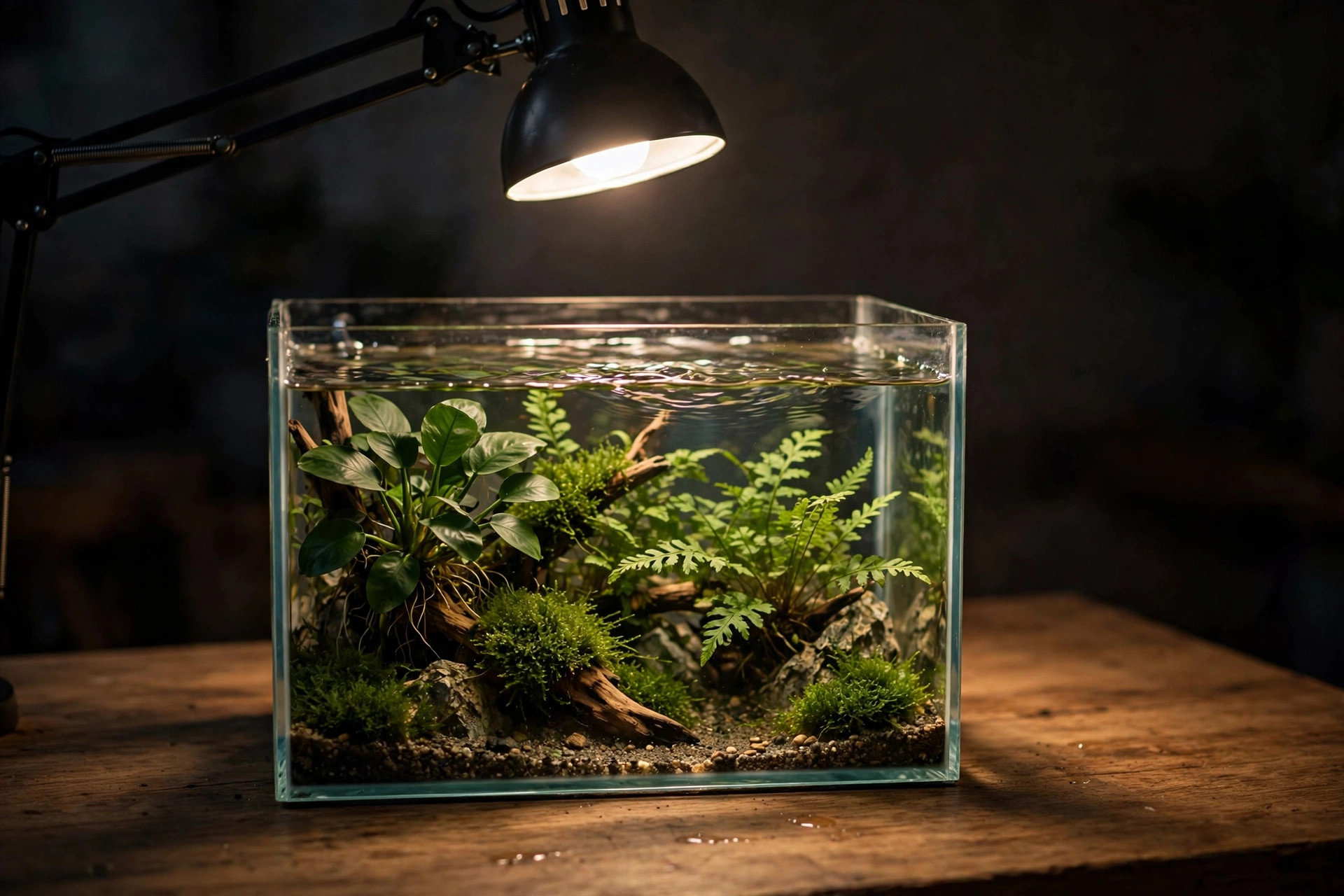
Lighting is the hobby's favorite budget trap: ask any forum and you'll get a dozen fixture recommendations before anyone asks what you're growing. Meanwhile a lamp is already sitting on your desk, pointed roughly at the tank.
Can aquarium plants really live under it? Yes — for some plants, on some tanks — as long as you fix the one thing most people get wrong. It's almost never the lamp body that fails. It's the bulb screwed into it.
The short answer: Yes — with a 6500K daylight LED bulb screwed in. Anubias, Java fern, mosses, hornwort, and crypts will grow under a desk lamp on a tank of about 10 gallons or less: lamp 6–12 inches above the water, 6–8 hours a day on a timer. Red stems, carpeting plants, and deep tanks need a real planted-tank light.
It's the Bulb That Matters, Not the Lamp
Plants don't care about the lamp — only photons, in the right wavelengths and quantity. Most desk lamps fail only because the bulb inside was chosen to make a living room feel cozy, not to feed photosynthesis.
The fix is one number on the box: 6500K. That's the closest cheap bulbs get to daylight, and it keeps your tank looking natural instead of yellow. Aim for CRI 80+ (greens look green) and 9–15W LED — roughly 800–1500 lumens, which is genuinely low-light PAR at the substrate of a tank up to 10 gallons.
One concrete option is the Sunlite 6500K daylight LED bulb ★4.3: a 15W A19 bright enough to cover a small tank from a desk lamp.
Don't use an old incandescent — it cooks the water surface and burns out fast. A 6500K daylight CFL works in a pinch but dims after months. LED is the right call.
Which Plants Actually Thrive Under a Desk Lamp
This is where honesty sets the strategy: under a desk lamp you're running a low-light, low-tech tank, so pick shade plants. Five nearly unkillable picks:
- Anubias: glues to driftwood and actively prefers low light.
- Java fern: the classic shade epiphyte; babies sprout from the leaf tips on their own.
- Java moss / Christmas moss: drape on wood or stone and creep outward with almost no input.
- Hornwort: floats or plants, grows fast under weak light, and outcompetes algae.
- Cryptocoryne (wendtii): tolerates shade, though expect initial melt — the roots almost always bounce back.
Unsure where a species falls? Tropica's plant database labels every plant's light needs — anything "easy" is usually desk-lamp safe. The boundary: red plants and carpeting plants are off the table. Rotala won't stay red and Monte Carlo won't carpet. That's physics, not failure.
Setting It Up: Distance, Angle, and Time
Three numbers run the whole operation. Distance: 6–12 inches above the water, angled so the beam covers the whole footprint. Time: 6–8 hours daily, on the same schedule every day.
Consistency is non-negotiable — algae loves "whenever I remember." Plug the lamp into a digital timer and forget about it. A BN-LINK 7-day digital outlet timer ★4.4 switches the lamp on/off to the minute and survives power blips better than the mechanical-dial type.
Disclosure: the product links above are Amazon affiliate links — I earn a small commission if you buy through them, at no extra cost to you. Both were verified live before linking.
| Bulb type | Verdict |
|---|---|
| LED 6500K daylight | Best choice — cool, cheap, right spectrum |
| CFL 6500K daylight | Acceptable spare — dims after a few months |
| Warm white 2700K LED | Avoid — yellow cast, leggy growth |
| Incandescent | Never — heat and short life |
The PAR Reality Check: What a Desk Lamp Can't Do
A 15W LED over a 5–10 gallon tank delivers roughly low-light PAR (about 15–30 at the substrate — Java fern and anubias territory). A real, growable zone. But with honest limits:
- Growth is slow. Anubias under a desk lamp might unfurl one leaf a month. That's the deal — don't chase it with fertilizer; you'll just feed algae.
- Deep tanks are out. Light falls off with depth, so this belongs to shallow nano tanks.
- Coverage is uneven. A lamp is a point source — put your moss and anubias in the dimmer edges.
If plants stretch tall and gappy toward the light, that's etiolation — the sign you've crossed from "low light" into "not enough." Move the lamp closer or step up to a brighter bulb.
When It's Time to Upgrade
The desk lamp gets you started, proves the hobby works on your desk, and keeps a betta or shrimp tank green for years. Upgrade when you want faster growth, reds or carpets, or constant algae. A clip-on nano LED costs little more than a good desk lamp and clamps to the glass — see our best clip-on lights for nano planted tanks and our guide to the best LED lights for low-tech planted tanks.
Until then: right bulb, right distance, right schedule. The lamp you already own is a perfectly good beginning.
Frequently Asked Questions
Will a desk lamp cause algae?
Any light can, if it outruns your plants. Keep the lamp to 6–8 hours on a timer, stock only low-light plants, and dose fertilizer sparingly — slow growers need far less than the bottle suggests.
How many hours a day should the lamp stay on?
Six to eight. Start at six and extend toward eight only if plants grow cleanly with no algae. Longer invites green water and hair algae, even at low intensity.
Can I use a warm-white bulb or a CFL instead?
A 6500K daylight CFL works as a stopgap. A warm-white 2700K bulb is a poor choice — yellow cast, leggy growth, harder-to-spot algae. A 6500K LED bulb is cheap enough that compromise isn't worth it.
Can a desk lamp light a tank bigger than 10 gallons?
Not well. Light falls off with depth, so deeper tanks get little usable light at the substrate. Two lamps can cover a long 20-gallon, but a proper LED fixture usually costs less and performs better.